

It is the first question almost everyone asks, and it is the one that keeps people up the night before an event. Order too little and you are the host who ran out. Order too much and you paid for food that went in the bin. Here are the figures worth planning against, and the handful of adjustments that matter more than the arithmetic does.
Start with the clock, not the headcount
Guest count tells you how many people are eating. The length of the event tells you how much each one eats. A two hour cocktail reception and a five hour wedding with the same 120 guests are completely different orders.
A rough rule that holds up well: people eat most in the first hour, then settle into a slower pace of roughly half that for every hour after. Plan the first hour generously and the rest will look after itself.
Passed appetizers
- Before a seated dinner, one hour: 4 to 6 pieces per person.
- Extended reception, two hours, dinner to follow: 6 to 8 pieces per person.
- Appetizers as the meal: 12 to 15 pieces per person, across at least six different items.
Variety matters as much as volume here. Six options at eight pieces each reads as abundant. Three options at sixteen pieces each reads as repetitive, even though it is the same amount of food.
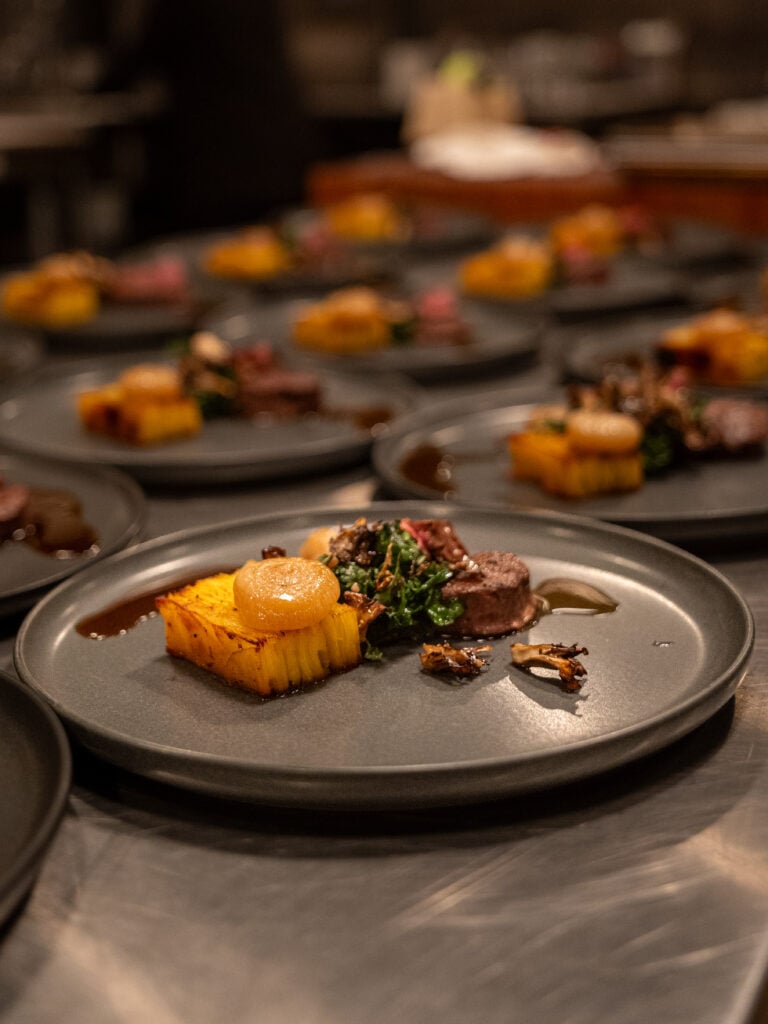
The main course
Protein is where most of the budget sits, so it is worth getting right. These are cooked weights, which is what ends up on the plate rather than what gets ordered.
- One protein on the menu: 6 to 8 ounces per person.
- Two proteins: 4 to 5 ounces of each. People take some of both.
- Three or more: 3 to 4 ounces of each.
Buffets run about 15 percent higher than plated service for the same guest count, because guests serve themselves and portions drift upward. If you are close to your budget ceiling, plated service stretches the same food further.
How much meat per person for catering?
The figures above are cooked weights. Meat loses roughly a quarter to a third of its weight in cooking, so what you order is more than what lands on the plate. That gap is where most orders go wrong.
| Cut | Cooked, per person | Order, per person |
|---|---|---|
| Boneless beef, pork or chicken | 6 to 8 oz | 8 to 11 oz |
| Bone-in chicken | 6 to 8 oz | 12 to 14 oz |
| Bone-in roast or ribs | 6 to 8 oz | 14 to 16 oz |
| Whole roast turkey or ham | 6 oz | 1 to 1.25 lb |
| Ground meat | 5 to 6 oz | 6 to 7 oz |
Two things shift those numbers. A carving station runs higher, because a server plating to order gives a more generous portion than a guest serving themselves from a tray. And a menu with a substantial starch or a second hot dish runs lower, because the plate fills before the protein does.
Sides, salad and bread
- Each side dish: 4 ounces per person, whatever the number of sides.
- Salad: 1 to 1.5 ounces of greens per person, which is about a cup loosely packed.
- Bread or rolls: 1.5 per person. Nobody eats two, plenty eat one and a half.
Two well chosen sides beat four mediocre ones, and they cost less to execute properly.
How many people does a half tray feed?
A half tray feeds about 8 to 12 people as a main dish, or 15 to 20 as a side. The spread is wide because it depends on the dish and on how deep the tray is, so it is worth knowing which you are being quoted.
| Tray | Size | As a main | As a side |
|---|---|---|---|
| Third tray | 13 x 7 in | 5 to 7 | 9 to 12 |
| Half tray, shallow | 13 x 10 in, 2.5 in deep | 8 to 10 | 15 to 18 |
| Half tray, deep | 13 x 10 in, 4 in deep | 10 to 12 | 18 to 20 |
| Full tray, shallow | 21 x 13 in, 2.5 in deep | 18 to 20 | 30 to 35 |
| Full tray, deep | 21 x 13 in, 4 in deep | 22 to 25 | 35 to 40 |
Pasta, casseroles and rice go further than the top of those ranges. Anything with a large piece of protein in it goes less far. If you are ordering by the tray for a buffet, count on people taking from every tray on the line rather than choosing one, which is the most common reason a tray count comes up short.
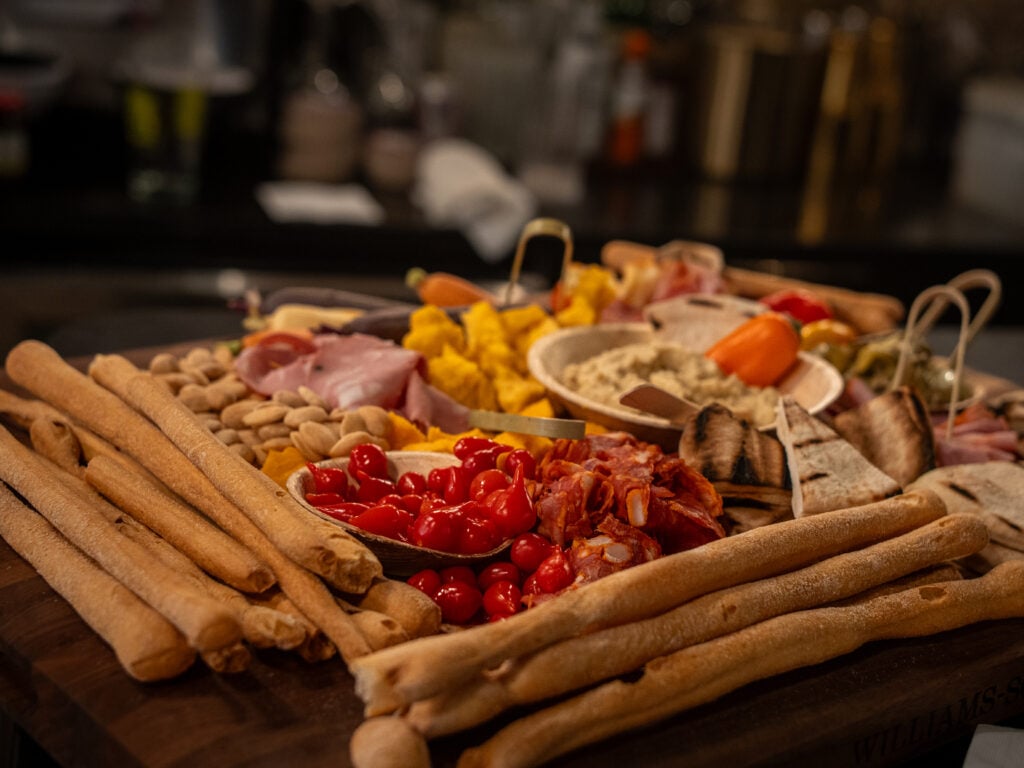
Grazing tables and charcuterie
- As a starter, with a meal to follow: 2 ounces of cheese and 2 ounces of cured meat per person.
- As the centerpiece, no meal to follow: 4 to 5 ounces of each, plus fruit, nuts, spreads and something warm.
A grazing table is also the one item where presentation does real work on perceived quantity. The same weight of food looks generous spread across a long table and looks thin on a single board.
Dessert and drinks
- Dessert: 1 to 1.5 pieces per person. If there is a cake as well, count 1.
- Coffee: one gallon per 20 guests, and more for an evening event.
- Water: 1 to 2 bottles per person indoors. Double that for anything outdoors in July or August.
- Soft drinks: 2 to 3 servings per person across a three hour event.
Five adjustments that matter more than the math
- Time of day. An event that runs through a normal mealtime needs a full meal. One that starts at 2pm needs far less than the headcount suggests.
- Standing or seated. Standing guests eat more small items and fewer large ones. Seated guests do the opposite.
- Outdoors in summer. Appetite drops, thirst climbs. Shift budget from food to drinks and keep the heavy dishes off the menu.
- Children. Count anyone under 12 as half an adult for food and skip them entirely on protein.
- A late finish. Anything running past 10pm wants a second wave, even something simple. It is the difference between guests leaving early and guests staying.
Planning for dietary restrictions
Ask about dietary needs on the invitation or registration form, and pass the caterer a count for each one. A specific count of four vegetarians and two gluten-free guests is easy to plan around. A note that says some guests have dietary restrictions usually ends up as an extra tray that comes home untouched, which is one of the most common sources of food waste at catered events.
- Vegetarian and plant-based guests: plan a full main for each one at the same portion size as the meat, 6 to 8 ounces, plus about 10 percent extra. Other guests take some of it, especially on a buffet. A plate of sides with no main leaves these guests hungry.
- Gluten-free guests: count them as full portions of protein and sides. Choosing one or two sides that are naturally gluten-free, such as roasted vegetables, rice or potatoes, gives them a full plate without a separate menu.
- Serious allergies: get the guest’s name and the specific allergy. For a nut, shellfish or celiac allergy, a separately prepared and labeled plate is safer than a buffet line, where shared serving spoons mix food between dishes.
- Labels: on a buffet, label every dish with its name and its main allergens. Guests with restrictions can choose for themselves, and the line keeps moving.
How do you calculate catering per person?
Four steps, in this order. Doing them out of order is what produces a number that looks right and is wrong.
- Take the confirmed headcount, not the invited count. Plan on the people who said yes. For a public or drop-in event, use the realistic attendance rather than the optimistic one.
- Adjust for who is eating. Count anyone under 12 as half, and leave them off the protein entirely. A room that skews older eats noticeably less than a room of twenty-somethings.
- Set the per-person quantity by course. Use the figures above: pieces for appetizers, ounces for protein, ounces or cups for sides. Multiply each by the adjusted headcount.
- Add the service allowance last. Ten percent on top for a plated dinner, closer to twenty for a buffet, where guests serve themselves and portions run larger.
For cost per head rather than quantity, the arithmetic is food plus labor plus rentals, divided by the guest count. Labor is the part people forget, and it is the reason a drop-off lunch and a plated dinner with similar food land at very different prices.
A worked example
One hundred guests, four hour evening reception, seated dinner, two proteins, indoors.
- Passed appetizers: 500 to 600 pieces across six items
- Protein: about 28 pounds cooked, split across the two
- Two sides: 25 pounds each
- Salad: 8 to 9 pounds of greens
- Rolls: 150
- Dessert: 100 to 150 pieces
- Coffee: 5 gallons
Run those numbers for your own event and you will land close enough to have a useful conversation with any caterer.
When to stop calculating
These figures get you to a sensible starting point. They do not account for the room, the season, the run of show, or the fact that your guests are individuals rather than averages. That part comes from having catered enough events in Kenosha County to know how a July lakefront reception behaves differently from a December office party.
If you are planning something and want the quantities checked against the actual shape of your event, we are happy to work through it with you. Take a look at corporate and event catering, private dinners and celebrations, or wedding catering, then tell us about your event and we will put real numbers to it.